Love this? Save it for later!
Share the inspiration with your friends
I was standing in the frozen foods aisle of my local grocery store last November, staring at a 16-pound turkey like it was a math problem I couldn’t solve, when the smell hit me. Not a store smell—a memory smell. It was the sharp, grassy scent of fresh rosemary mingling with the sweetness of roasting onions, and suddenly I was twelve years old in my neighbor Mrs. Kowalski’s tiny kitchen, watching her flip a turkey over like it was nothing. She caught me staring and laughed. “The secret, kiddo, is to make it lie flat,” she said, pressing the bird down with the heel of her hand until the backbone cracked. I remember being horrified and fascinated at the same time. She passed away three years ago, and I never got her recipe. But that moment in the grocery store—the rosemary, the memory, the way she didn’t care about proper technique—sent me home with a turkey and a mission. I spent two Thanksgivings failing before I figured it out. Honestly, the first one came out so dry my dog wouldn’t even eat it. But this version? This is the one Mrs. Kowalski would approve of. Maybe you’ve been intimidated by the whole turkey thing too. I get it. But once you try it spatchcocked, you’ll never go back.
Why You’ll Love This Recipe
Let me tell you why this spatchcock turkey recipe has become my absolute go-to for holidays and Sunday dinners alike. I’ve tested this method on six different birds over the past two years, tweaking the butter mixture and roasting times until everything clicked. The results were so consistent that my brother-in-law—who swears by his deep-fried turkey—asked for the recipe. That’s when I knew I had something special.
- Incredibly Juicy Meat: Spatchcocking forces the turkey to cook evenly, so white meat stays moist while dark meat reaches perfect doneness. No more dry breast meat arguments at the table.
- Crispy, Golden Skin: The herb butter gets rubbed both under and over the skin, creating layers of flavor and that shatteringly crisp exterior everyone fights over.
- Ready in Half the Time: A traditional whole turkey takes forever. This method cuts roasting time by nearly 40%, freeing up your oven for all those side dishes.
- Simple, Everyday Ingredients: No fancy equipment or exotic spices. Just butter, fresh herbs, garlic, and a good bird. You probably have most of this in your kitchen right now.
- Perfect Pan Gravy: Because the turkey lies flat, the pan drippings concentrate beautifully, giving you the richest, most flavorful gravy without any extra steps.
This isn’t just another turkey recipe. The technique of spatchcocking—removing the backbone and flattening the bird—changes everything about how turkey cooks. It’s the difference between a stressful, hours-long ordeal and a relaxed, enjoyable cooking experience. When you take that first bite and the herb butter hits your tongue, you’ll understand why this method has converted even the most stubborn turkey traditionalists. It’s comfort food at its finest, the kind of meal that makes everyone at the table close their eyes and sigh.
What Ingredients You Will Need
This recipe relies on simple, fresh ingredients to build deep, layered flavor. Most of these are pantry staples or easy to find at any grocery store. The key is using fresh herbs—they really do make a difference here.
For the Turkey and Herb Butter
- 1 whole turkey (12-14 pounds / 5.4-6.3 kg), thawed completely if frozen. I prefer a fresh bird when possible, but frozen works great too. Just give it 3-4 days in the fridge to thaw.
- 1 cup (2 sticks / 226 g) unsalted butter, softened to room temperature. Don’t use margarine—the flavor just isn’t the same. I like Kerrygold for its richness.
- 4 cloves garlic, minced finely (about 2 tablespoons). Fresh garlic is non-negotiable here. Skip the jarred stuff.
- 2 tablespoons fresh rosemary, finely chopped. The piney, aromatic flavor is what makes this turkey special.
- 2 tablespoons fresh thyme leaves, removed from stems. Lemon thyme adds a lovely citrus note if you can find it.
- 2 tablespoons fresh sage, finely chopped. Sage and turkey are a classic pairing for good reason.
- 1 tablespoon fresh parsley, finely chopped. Adds freshness and color.
- 2 teaspoons kosher salt, plus more for seasoning. Diamond Crystal is my go-to—it’s less salty by volume, so you can season generously.
- 1 teaspoon black pepper, freshly ground. Pre-ground pepper lacks the punch you need here.
- 1 lemon, zested and halved. The zest goes into the butter, and the halves go into the cavity for extra moisture.
For the Pan Gravy
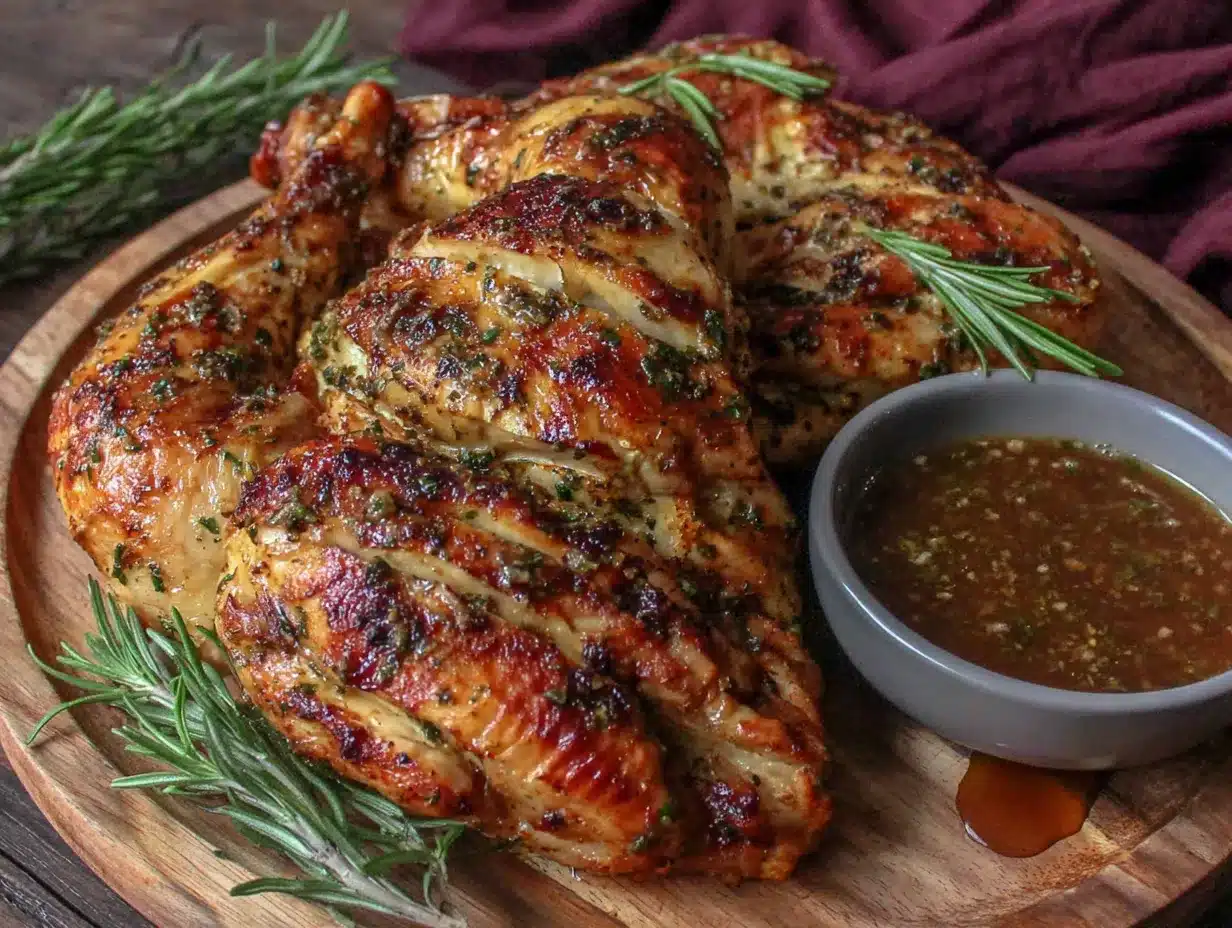
- Pan drippings from the roasted turkey (about 1/2 cup / 120 ml). Don’t skim the fat—that’s where the flavor lives.
- 1/4 cup (30 g) all-purpose flour. For thickening. Use a gluten-free flour blend if needed.
- 2 cups (480 ml) low-sodium chicken or turkey broth, warmed. Homemade is amazing, but store-bought works in a pinch. I prefer Swanson’s unsalted.
- 1/2 cup (120 ml) dry white wine, optional but recommended. A crisp Sauvignon Blanc adds acidity that balances the richness.
- Salt and pepper to taste.
Equipment Needed
You don’t need a lot of fancy gear for this recipe, but a few specific tools make the job much easier. Here’s what I use and what you can substitute if needed.
- Sharp kitchen shears: These are essential for cutting out the backbone. Regular scissors won’t work—they’re not strong enough. I’ve had my pair of OXO shears for over a decade, and they’re still going strong. If you don’t have shears, ask your butcher to spatchcock the turkey for you. Most will do it for free.
- Large rimmed baking sheet: A half-sheet pan (18×13 inches) is perfect. The rim catches all the drippings for gravy. I learned the hard way that a flat cookie sheet leads to a very smoky oven.
- Wire rack: Placing the turkey on a rack elevates it, allowing hot air to circulate underneath for even cooking and crispy skin. No rack? No problem. Roll up a few balls of aluminum foil and place them under the bird.
- Instant-read thermometer: This is non-negotiable for food safety and perfect doneness. I use a Thermapen—it’s pricey but worth every penny. A basic digital thermometer works fine too.
- Meat mallet or rolling pin: For flattening the breastbone after spatchcocking. You can also use your hands if you’re strong enough, but the mallet makes it effortless.
- Small saucepan: For making the gravy on the stovetop while the turkey rests.
- Whisk: A flat whisk works best for gravy, but any whisk will do.
Preparation Method
Take your time with these steps. Rushing leads to mistakes, and with a turkey, mistakes are expensive. I’ve made every error in the book so you don’t have to.
- Prepare the turkey for spatchcocking. Remove the turkey from its packaging and take out the giblets and neck (save those for stock!). Pat the bird completely dry with paper towels—inside and out. This is crucial for crispy skin. Place the turkey breast-side down on your cutting board with the legs facing you.
- Remove the backbone. Using your sharp kitchen shears, cut along one side of the backbone, starting at the tail end and working toward the neck. It takes some force—don’t be shy. Repeat on the other side. The backbone will come out in one piece. Save it for stock or discard it. Mrs. Kowalski always saved hers for soup the next day.
- Flatten the turkey. Flip the turkey over so it’s breast-side up. Place your hands on the breastbone and press down firmly until you hear a crack. If it doesn’t crack easily, use a meat mallet or rolling pin to gently flatten the breastbone. The turkey should lie completely flat. If it’s still domed, you haven’t pressed hard enough.
- Tuck the wing tips. Fold the wing tips underneath the turkey so they don’t burn. This also creates a stable base for the bird to sit on.
- Make the herb butter. In a medium bowl, combine the softened butter, minced garlic, chopped rosemary, thyme, sage, parsley, lemon zest, 2 teaspoons kosher salt, and 1 teaspoon black pepper. Mix until everything is evenly distributed. Taste it—yes, raw butter. It should taste bright and herbal. Adjust seasoning if needed.
- Apply the herb butter. Using your fingers, gently loosen the skin over the turkey breast, thighs, and legs. Be careful not to tear the skin. Slide about two-thirds of the herb butter under the skin, spreading it evenly over the meat. Rub the remaining butter all over the outside of the turkey, getting into every nook and cranny. Place the lemon halves inside the cavity area.
- Season the bird. Sprinkle the outside of the turkey with additional kosher salt and black pepper. Don’t skimp—this is your only chance to season the skin.
- Preheat and prepare the pan. Preheat your oven to 425°F (218°C). Place a wire rack inside your rimmed baking sheet. If you don’t have a rack, crumple four long pieces of aluminum foil into snake shapes and arrange them on the pan to elevate the turkey.
- Roast the turkey. Place the turkey flat on the rack, breast-side up. Roast for about 12-15 minutes per pound. For a 12-pound turkey, that’s roughly 1 hour and 30 minutes to 1 hour and 45 minutes. Start checking the temperature at the 1-hour mark. The turkey is done when the thickest part of the breast reaches 155°F (68°C) and the thickest part of the thigh reaches 170°F (77°C). The temperature will rise another 5-10 degrees while resting.
- Rest the turkey. Remove the turkey from the oven and transfer it to a cutting board. Let it rest for at least 20-25 minutes before carving. Do not skip this step—it allows the juices to redistribute. Tent loosely with foil if you want, but don’t wrap it tightly or the skin will soften.
Cooking Tips & Techniques
I’ve learned these lessons through trial and error, and honestly, some of them were hard-won. Let me save you the trouble.
Dry the turkey thoroughly. The number one mistake I see is people skipping this step. Moisture is the enemy of crispy skin. Pat that bird dry, then let it sit uncovered in the fridge for a few hours if you have time. The drier the skin, the crispier the result.
Don’t skip the resting period. I know it’s tempting to carve right away, especially when everyone is hungry and the kitchen smells amazing. But cutting into a hot turkey releases all those juices onto the cutting board instead of staying in the meat. I ruined my first spatchcock turkey by carving too soon, and the breast meat was noticeably drier. Give it those 20 minutes.
Watch the dark meat. Because the turkey lies flat, the thighs cook faster than in a traditional roast. This is actually a good thing—it means they reach safe temperature without drying out. But check them early. If the breast hits 150°F while the thighs are still at 165°F, you can always cover the breast with foil and let the thighs catch up.
Use a thermometer, not a timer. Ovens vary wildly, and turkey sizes are never exactly what the package says. Trust the numbers, not the clock. I once had a 14-pound turkey that was done in 90 minutes. Another time, a 12-pound bird took nearly 2 hours. Temperature is truth.
Make the gravy while the turkey rests. This is a great multitasking strategy. While your bird is resting, the pan drippings are still warm and ready to become gravy. Don’t let them sit and congeal.
Variations & Adaptations
This recipe is wonderfully flexible. Here are a few ways to make it your own.
Citrus-Herb Butter: Add the juice of half a lemon and half an orange to the butter mixture, along with a teaspoon of orange zest. The acidity cuts through the richness beautifully. I tried this last Christmas, and it was a hit with my citrus-loving sister-in-law.
Spicy Southwest Version: Replace the rosemary and sage with 2 teaspoons of smoked paprika, 1 teaspoon of cumin, 1/2 teaspoon of cayenne pepper, and 2 tablespoons of chopped cilantro. Add a tablespoon of lime zest to the butter. This version pairs amazingly with a side of black beans and rice.
Garlic and Herb Butter without Dairy: Substitute the butter with 3/4 cup of olive oil or melted ghee. Mix the herbs and garlic into the oil, then brush it under and over the skin. The oil won’t solidify like butter, so apply it right before roasting. I’ve used this version for dairy-free friends, and they raved about it.
Herb-Butter Spatchcock Chicken: This same method works perfectly for a 4-5 pound chicken. Reduce the roasting time to about 45-55 minutes, or until the breast hits 155°F. The herb butter recipe stays the same, just use less of it—about 4 tablespoons of butter will do.
Serving & Storage Suggestions
Serving: Carve the turkey by removing the legs and thighs first, then slicing the breast meat against the grain. Arrange the meat on a warm platter and spoon some of the pan gravy over the top. Serve the remaining gravy in a boat on the side. This turkey is fantastic with classic sides like mashed potatoes, roasted Brussels sprouts, and cranberry sauce. A full-bodied Chardonnay or a light Pinot Noir pairs beautifully.
Storage: Leftover turkey keeps in an airtight container in the refrigerator for up to 4 days. The meat actually gets more flavorful as it sits. For longer storage, slice or shred the turkey and freeze it in a freezer-safe bag for up to 3 months. Press out as much air as possible before sealing.
Reheating: The best way to reheat leftover turkey is in a low oven. Place the meat in a baking dish, add a splash of chicken broth or gravy, cover with foil, and warm at 300°F (150°C) for 15-20 minutes. This prevents the meat from drying out. Avoid the microwave if you can—it tends to toughen the meat. The gravy reheats beautifully on the stovetop over low heat, whisking occasionally.
Flavor development: The herb butter flavors continue to meld with the meat overnight. I actually think the cold leftovers make the best sandwiches the next day, especially on sourdough with a smear of cranberry sauce.
Nutritional Information & Benefits
Turkey is a lean, high-protein meat that’s packed with nutrients. A 4-ounce (113 g) serving of roasted turkey breast (without skin) provides approximately:
- Calories: 190
- Protein: 34 grams
- Fat: 5 grams
- Carbohydrates: 0 grams
- Iron: 8% of the Daily Value (DV)
- Zinc: 12% of the DV
- Vitamin B6: 25% of the DV
- Niacin: 40% of the DV
The fresh herbs in this recipe add more than just flavor. Rosemary contains antioxidants like rosmarinic acid, which has anti-inflammatory properties. Thyme is rich in vitamin C and vitamin A. Garlic is well-known for its immune-boosting compounds. This recipe is naturally gluten-free (use a gluten-free flour blend for the gravy) and can be made dairy-free by substituting the butter with olive oil. It’s also low-carb and keto-friendly if you skip the flour in the gravy. The only potential allergen is dairy from the butter, which is easily swapped.
Conclusion
This spatchcock turkey has become my go-to for every special occasion, and I honestly think it will become yours too. The herb butter infuses the meat with incredible flavor, the quick roasting time means less stress, and that pan gravy is pure gold. It’s the kind of recipe that makes you look like a hero in the kitchen without actually having to work that hard. I love that I can make this for a holiday feast or a random Sunday dinner and get the same amazing results every time.
I’d love to hear how this recipe turns out for you. Did you try a variation? Did your family fight over the crispy skin? Drop a comment below and let me know. And if you have a favorite herb combination you swear by, share that too—I’m always looking for new ideas. Here’s to stress-free, delicious turkey that brings everyone to the table.
Frequently Asked Questions
Can I spatchcock a frozen turkey?
No, you need to fully thaw the turkey first. Spatchcocking a partially frozen bird is nearly impossible and unsafe. Give yourself 3-4 days in the refrigerator for a 12-14 pound turkey to thaw completely.
Do I have to use fresh herbs?
Fresh herbs really do make a difference here, but if you only have dried, use 1 teaspoon of each dried herb instead of 1 tablespoon fresh. The flavor won’t be as bright, but it will still be good. Rehydrate the dried herbs in a tablespoon of olive oil before mixing them into the butter.
What do I do with the backbone?
Save it! The backbone is perfect for making turkey stock. Throw it in a pot with some onion, carrot, celery, and water, and simmer for a few hours. You’ll have amazing stock for soup or for making gravy next time.
Can I cook stuffing inside a spatchcock turkey?
Technically no, because the turkey lies flat and there’s no cavity to hold stuffing. I recommend making your stuffing separately in a baking dish. You can drizzle some of the pan drippings over it for extra flavor.
Why is my turkey skin not crispy?
Most likely, the skin wasn’t dry enough before roasting. Next time, pat the turkey dry with paper towels and let it sit uncovered in the fridge for a few hours or overnight. Also, make sure your oven is fully preheated to 425°F before putting the turkey in.
Pin This Recipe!
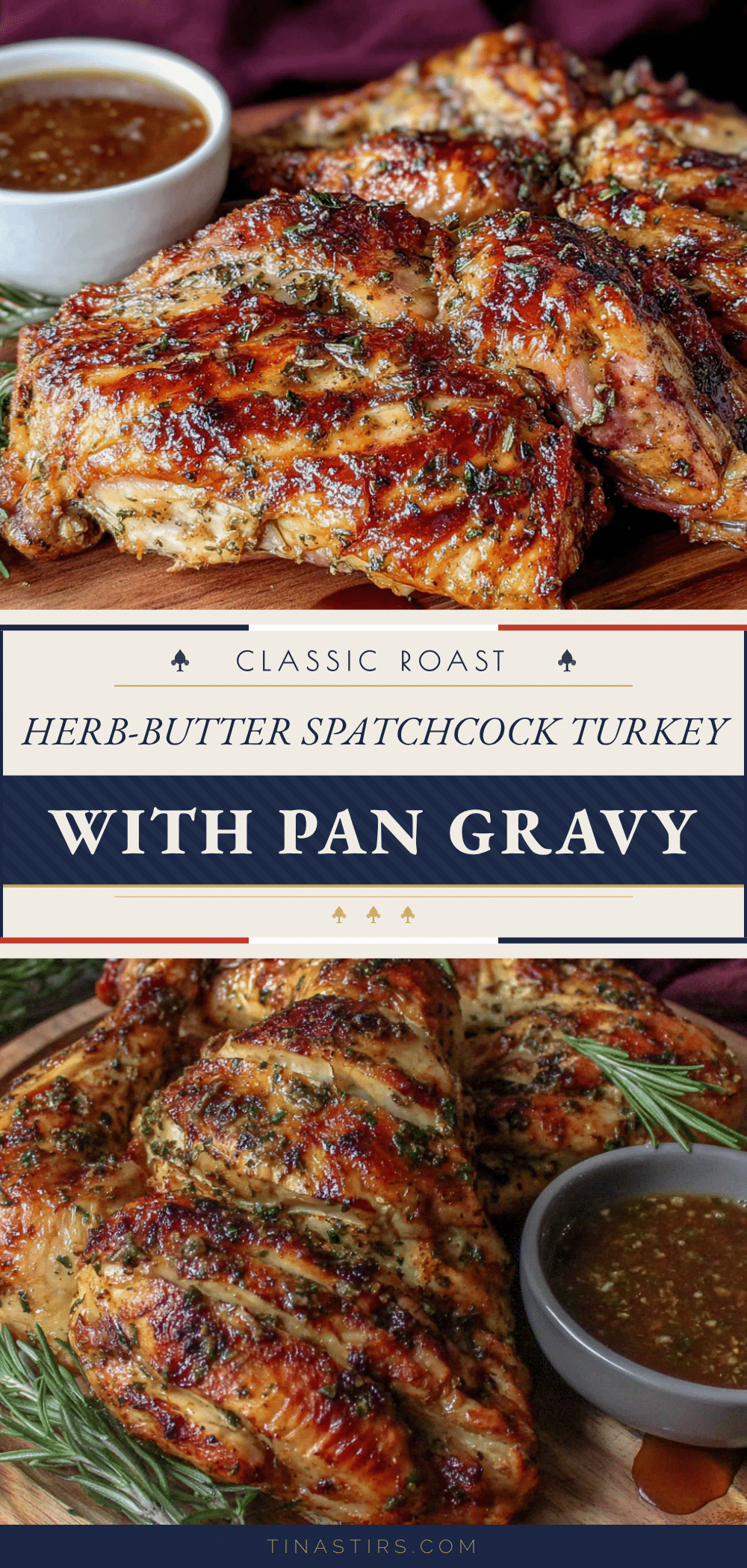
Classic Herb-Butter Spatchcock Turkey: Easy, Perfect Pan Gravy
This spatchcock turkey recipe delivers incredibly juicy meat with crispy, golden skin in half the time of a traditional roast. The herb butter infuses the bird with flavor, and the pan drippings create a rich, perfect gravy.
- Prep Time: 30 minutes
- Cook Time: 1 hour 30 minutes
- Total Time: 2 hours 30 minutes
- Yield: 12 servings 1x
- Category: Main Course
- Cuisine: American
Ingredients
- 1 whole turkey (12–14 pounds / 5.4–6.3 kg), thawed completely
- 1 cup (2 sticks / 226 g) unsalted butter, softened
- 4 cloves garlic, minced (about 2 tablespoons)
- 2 tablespoons fresh rosemary, finely chopped
- 2 tablespoons fresh thyme leaves
- 2 tablespoons fresh sage, finely chopped
- 1 tablespoon fresh parsley, finely chopped
- 2 teaspoons kosher salt, plus more for seasoning
- 1 teaspoon black pepper, freshly ground
- 1 lemon, zested and halved
- Pan drippings from roasted turkey (about 1/2 cup / 120 ml)
- 1/4 cup (30 g) all-purpose flour
- 2 cups (480 ml) low-sodium chicken or turkey broth, warmed
- 1/2 cup (120 ml) dry white wine (optional)
- Salt and pepper to taste
Instructions
- Prepare the turkey for spatchcocking: Remove turkey from packaging, remove giblets and neck, and pat completely dry with paper towels. Place breast-side down on cutting board with legs facing you.
- Remove the backbone: Using sharp kitchen shears, cut along one side of the backbone from tail to neck, then repeat on the other side. Remove backbone and save for stock or discard.
- Flatten the turkey: Flip turkey breast-side up. Press down firmly on breastbone until it cracks. Use a meat mallet or rolling pin if needed. Turkey should lie completely flat.
- Tuck the wing tips: Fold wing tips underneath the turkey to prevent burning and create a stable base.
- Make the herb butter: In a medium bowl, combine softened butter, minced garlic, chopped rosemary, thyme, sage, parsley, lemon zest, 2 teaspoons kosher salt, and 1 teaspoon black pepper. Mix until evenly distributed.
- Apply the herb butter: Gently loosen skin over breast, thighs, and legs. Slide about two-thirds of herb butter under skin, spreading evenly. Rub remaining butter all over outside of turkey. Place lemon halves inside cavity area.
- Season the bird: Sprinkle outside of turkey with additional kosher salt and black pepper.
- Preheat and prepare the pan: Preheat oven to 425°F (218°C). Place a wire rack inside a rimmed baking sheet. If no rack, crumple aluminum foil into snake shapes to elevate turkey.
- Roast the turkey: Place turkey flat on rack, breast-side up. Roast for about 12-15 minutes per pound (for a 12-pound turkey, about 1 hour 30 minutes to 1 hour 45 minutes). Start checking temperature at 1-hour mark. Turkey is done when thickest part of breast reaches 155°F (68°C) and thickest part of thigh reaches 170°F (77°C).
- Rest the turkey: Remove from oven and transfer to cutting board. Let rest for at least 20-25 minutes before carving. Tent loosely with foil if desired.
Notes
Dry the turkey thoroughly for crispy skin. Do not skip the resting period. Use a thermometer, not a timer. Make gravy while turkey rests. For dairy-free, substitute butter with olive oil or melted ghee.
Nutrition
- Serving Size: 4 ounces (113 g) roa
- Calories: 190
- Sodium: 400
- Fat: 5
- Saturated Fat: 2
- Protein: 34
Keywords: spatchcock turkey, herb butter turkey, roasted turkey, Thanksgiving turkey, easy turkey recipe, crispy skin turkey, pan gravy