Love this? Save it for later!
Share the inspiration with your friends
The sourdough starter on my counter had been staring at me for three days. I had named it Gertrude by then, mostly because I talk to my starters and that feels less weird when they have names. Gertrude was bubbly and ready, but I wasn’t in the mood for another plain boule. Honestly, I was tired of the same old crusty loaves that everyone and their neighbor was posting on social media.
Then I spotted three sad-looking cans of pumpkin puree in my pantry, left over from a pie experiment that went sideways in October. It was November, and the craving for something warm and spiced was hitting me hard. I wanted bread that smelled like autumn, that made the kitchen feel like a hug. So I dumped some pumpkin into Gertrude’s feeding schedule and held my breath.
The first attempt was a disaster. The dough was too wet, the cinnamon sank to the bottom, and the sugar crystallized into weird crunchy spots. My kitchen looked like a flour bomb had gone off, and I had dough stuck to my hair. But that second batch? That second batch was the one where everything clicked. The dough felt silky, the cinnamon swirled through like a ribbon, and the sugar formed this delicate, crackly crust on top. When I pulled it from the oven, the whole house smelled like a bakery in a storybook.
Maybe you’ve been there, staring at your starter and wondering what else it can do besides sourdough loaves and discard crackers. Let me tell you, this pumpkin sourdough bread is the answer. It’s cozy, it’s forgiving, and it makes your house smell like you have your life together—even if you don’t.
Why You’ll Love This Recipe
This isn’t just another pumpkin bread recipe that disappears after October. This is the bread that keeps showing up on your counter all winter long. Here is why this one is different from everything else out there.
- Perfectly Balanced Sweetness : The pumpkin keeps the crumb tender, while the cinnamon sugar topping adds just enough sweetness without making it taste like cake. It’s breakfast bread, snack bread, and dessert bread all in one.
- That Signature Sourdough Tang : The fermented starter adds a subtle tang that cuts through the sweetness. It makes the bread taste complex, not just sugary. Your taste buds will thank you.
- Simple Ingredients : You likely have everything in your kitchen right now. No weird stabilizers, no expensive extracts. Just flour, pumpkin, butter, and your trusty starter.
- Beginner-Friendly Dough : This dough is more forgiving than traditional sourdough. The pumpkin adds moisture and structure, so it’s harder to overproof or underbake. Perfect for sourdough newbies.
- Crowd-Pleaser : I brought this to a Friendsgiving gathering and three people asked for the recipe before I even sat down. Kids love it. Adults love it. Even my neighbor who “doesn’t like pumpkin” ate two slices.
- Freezes Beautifully : Make two loaves. Eat one now, freeze one for later. The cinnamon sugar topping stays crunchy even after thawing, which is basically a miracle.
This recipe is the kind that makes you close your eyes after the first bite. It’s comfort food reimagined—healthier than a muffin, more satisfying than plain toast, and way more impressive than it has any right to be.
What Ingredients You Will Need
This recipe uses simple, wholesome ingredients to deliver bold flavor and satisfying texture without the fuss. Most of these are pantry staples, which makes this bread perfect for spontaneous baking sessions.
For the Dough
- 1 cup (240g) pumpkin puree (not pumpkin pie filling—make sure it’s 100% pure pumpkin. I prefer Libby’s for consistent texture)
- 1/2 cup (120g) active sourdough starter (fed and bubbly, ideally at its peak. Discard can work but the rise will be less reliable)
- 2 1/2 cups (315g) all-purpose flour (bread flour works too, but all-purpose gives a softer crumb)
- 1/4 cup (60g) unsalted butter, melted (salted butter works if you reduce the added salt slightly)
- 1/4 cup (60ml) warm water (about 90°F—warm to the touch but not hot)
- 2 tablespoons (25g) brown sugar (light or dark, both work. Dark adds more molasses flavor)
- 1 teaspoon ground cinnamon (I use Saigon cinnamon for its bold, sweet warmth)
- 1/2 teaspoon ground nutmeg (freshly grated if you have it—it makes a difference)
- 1/2 teaspoon ground ginger (adds a subtle kick that complements the pumpkin)
- 1/4 teaspoon ground cloves (optional, but I love the depth it adds)
- 1 teaspoon salt (fine sea salt works best)
For the Cinnamon Sugar Topping
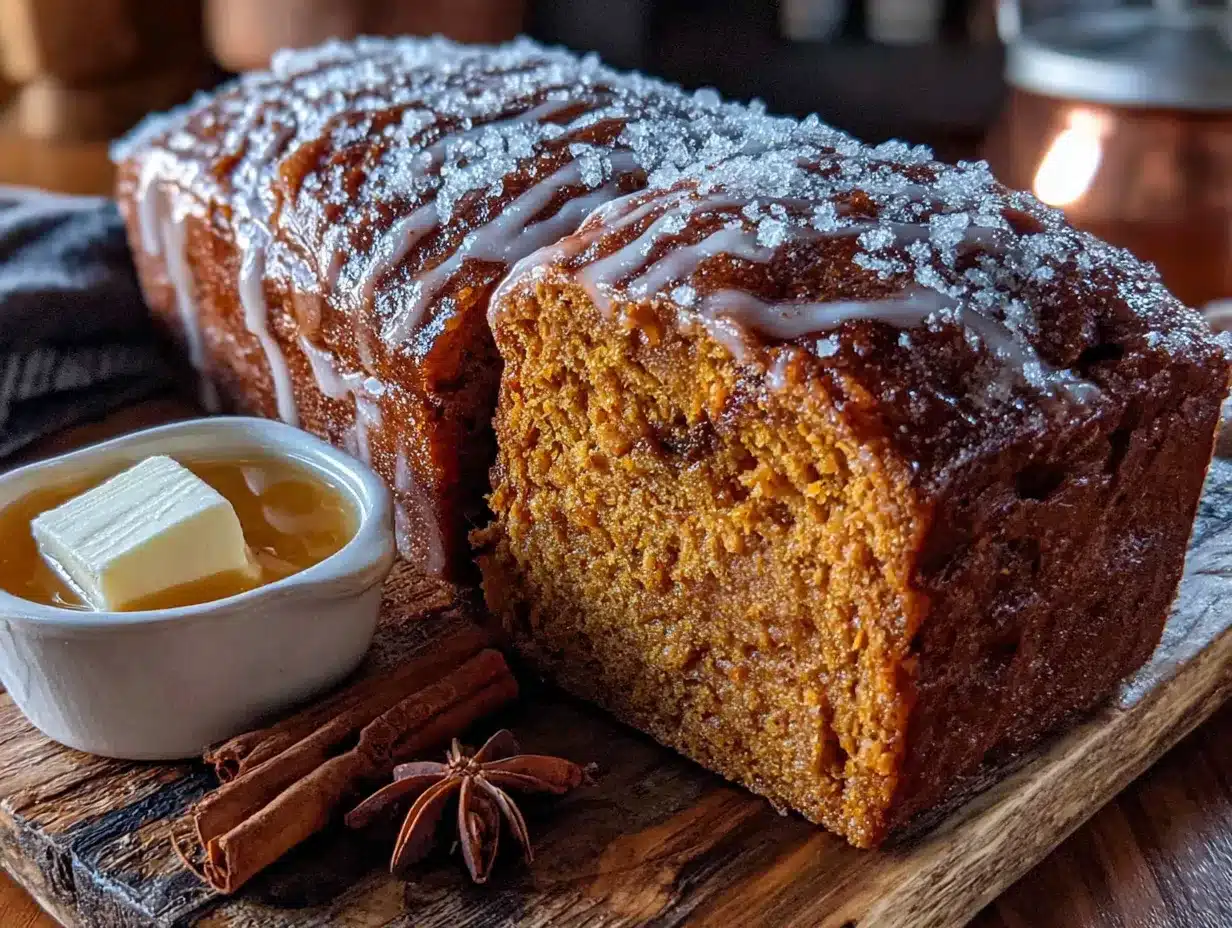
- 2 tablespoons (30g) granulated sugar
- 1 tablespoon (8g) ground cinnamon
- 1 tablespoon (15g) unsalted butter, melted (for brushing on top before baking)
Ingredient Tips: If your pumpkin puree looks watery, blot it with a paper towel before adding it to the dough. Too much liquid will make the dough sticky and hard to shape. For a dairy-free version, swap the butter with coconut oil or vegan butter—just make sure it’s melted and cooled slightly.
Equipment Needed
You don’t need fancy gadgets for this bread. Here is what you’ll need, plus some honest thoughts on what works best.
- Large mixing bowl (glass or ceramic—metal can react with the starter)
- Wooden spoon or dough whisk (I use a Danish dough whisk, but a sturdy spoon works fine)
- Plastic wrap or a clean kitchen towel (for covering the dough during proofing)
- 9×5 inch loaf pan (glass or metal—glass lets you see the browning on the sides)
- Parchment paper (for easy removal—trust me on this)
- Sharp knife or lame (for scoring the top—a serrated knife works in a pinch)
- Cooling rack (wire rack is best, but a cutting board works if you flip the bread after a few minutes)
- Pastry brush (for applying the butter topping—a silicone one is easiest to clean)
If you don’t have a loaf pan, you can shape this into a freeform boule on a baking sheet. The bake time will be slightly shorter, so start checking at 35 minutes.
Preparation Method
Let’s make some bread. This process takes a few hours, but most of it is hands-off waiting time. Put on some music, pour yourself a coffee, and enjoy the process.
- Feed your starter (4-6 hours before mixing): Make sure your sourdough starter is active and bubbly. Feed it 4-6 hours before you plan to mix the dough. It should double in size and smell fruity and tangy.
- Mix the wet ingredients (5 minutes): In a large bowl, combine the pumpkin puree, active starter, melted butter, and warm water. Stir until smooth. The mixture should look like thick orange soup—that’s perfect.
- Add the dry ingredients (3 minutes): Add the flour, brown sugar, cinnamon, nutmeg, ginger, cloves, and salt. Mix with a wooden spoon until a shaggy dough forms. It will look messy and lumpy. That’s okay. Cover the bowl with plastic wrap and let it rest for 30 minutes. This is called the autolyse, and it helps the flour absorb the liquid.
- Stretch and fold (2 minutes per fold, 4 rounds): After the rest, perform four rounds of stretch and folds, spaced 30 minutes apart. To do this, wet your hand slightly, grab one side of the dough, stretch it up, and fold it over itself. Rotate the bowl and repeat on all four sides. This builds structure without heavy kneading.
- Bulk fermentation (4-6 hours at room temperature): Cover the bowl and let it rise at room temperature. The dough should increase by about 50% in size and look puffy with small bubbles on top. Warmer kitchens will speed this up; cooler kitchens will slow it down. Go by look and feel, not the clock.
- Shape the dough (5 minutes): Lightly flour your work surface. Turn the dough out and gently shape it into a log. Don’t punch it down—you want to keep those air bubbles. Place the log into a parchment-lined loaf pan, seam side down.
- Cold proof (overnight or 8-12 hours): Cover the pan with plastic wrap and place it in the refrigerator. This slow proof develops flavor and makes the dough easier to handle. You can skip this step and bake after 2 hours at room temperature, but the flavor won’t be as deep.
- Preheat and prepare the topping (20 minutes): When you’re ready to bake, preheat your oven to 375°F (190°C). Mix the granulated sugar and cinnamon for the topping in a small bowl. Remove the dough from the fridge and let it sit at room temperature while the oven heats.
- Score and top (2 minutes): Brush the top of the dough with melted butter. Use a sharp knife to score a line down the center (about 1/2 inch deep). Sprinkle the cinnamon sugar mixture generously over the top. Don’t be shy—the sugar creates that gorgeous crackly crust.
- Bake (45-50 minutes): Place the pan on the middle rack. Bake for 45-50 minutes, until the top is deep golden brown and a skewer inserted into the center comes out clean. If the top is browning too quickly, tent it with foil at the 30-minute mark.
- Cool (1 hour minimum): Let the bread cool in the pan for 10 minutes, then transfer it to a wire rack. Wait at least 1 hour before slicing. I know it’s hard, but slicing too early will make the crumb gummy. The bread continues to set as it cools.
Cooking Tips & Techniques
I’ve made this bread about a dozen times, and I’ve learned a few things the hard way. Here are my best tips to save you from my mistakes.
Watch your dough hydration. Pumpkin puree varies wildly between brands. If your dough feels more like batter than dough after mixing, add an extra tablespoon of flour. It should be sticky but still hold its shape when you stretch it.
Don’t skip the cold proof. I tried baking this straight after bulk fermentation once, and the flavor was flat. That overnight rest in the fridge is where the magic happens. The tang develops, the cinnamon melds with the pumpkin, and the texture becomes tender.
Score with confidence. That first time I scored the dough, I barely scratched the surface. The bread burst open in the oven like a volcano. Now I score about half an inch deep, and I do it in one smooth motion. A sharp lame or razor blade works best, but a serrated knife does the job.
Butter is your friend. Brushing the top with melted butter before adding the cinnamon sugar does two things: it helps the sugar stick, and it creates a golden, glossy crust. Don’t skip this step. I once tried using water instead of butter, and the sugar just slid right off.
Check for doneness early. Every oven runs differently. Start checking your bread at 40 minutes. Insert a skewer into the center—if it comes out clean or with just a few moist crumbs, it’s done. If it’s still wet, give it 5 more minutes.
Variations & Adaptations
This bread is wonderfully flexible. Here are some ways to make it your own.
Gluten-Free Version : Substitute the all-purpose flour with a gluten-free 1:1 baking flour blend. Add 1 teaspoon of xanthan gum if your blend doesn’t include it. The texture will be slightly more dense, but the flavor is still fantastic. I tested this with Bob’s Red Mill 1:1 flour, and it worked beautifully.
Vegan Adaptation : Swap the butter with coconut oil or vegan butter. Use a flax egg (1 tablespoon ground flaxseed mixed with 3 tablespoons water) if you want extra structure, though the pumpkin and starter provide enough moisture on their own. The topping works with melted coconut oil instead of butter.
Spice It Up : Add 1/2 teaspoon of cardamom or allspice to the dough for a more complex flavor profile. I made a batch with cardamom and orange zest once, and it tasted like a fancy bakery loaf.
Chocolate Swirl : Before shaping, fold in 1/3 cup of dark chocolate chips or chunks. The warm cinnamon and chocolate combination is dangerously good. My kids devoured an entire loaf in one afternoon.
Nutty Crunch : Add 1/2 cup of toasted pecans or walnuts to the dough after the stretch and folds. The nuts add texture and make the bread feel more substantial. I like to chop them roughly so there are bigger pieces in every slice.
Savory Twist : Reduce the sugar to 1 tablespoon, skip the cinnamon sugar topping, and add 1/2 cup of grated sharp cheddar cheese and 1 tablespoon of fresh rosemary. The pumpkin and cheese combination is surprisingly amazing. Serve it with soup for a cozy dinner.
Serving & Storage Suggestions
This bread shines in so many ways. Here is how to enjoy it at its best.
Serving Temperature : Warm or room temperature, both work beautifully. If you want that fresh-from-the-oven experience, pop slices in a 300°F oven for 5 minutes. The cinnamon sugar topping gets slightly crispy again.
Perfect Pairings : Spread a slice with salted butter and a drizzle of honey for a simple breakfast. It’s also incredible with cream cheese frosting for a dessert twist. Serve it alongside a hot cup of chai or a pumpkin spice latte for the ultimate fall moment.
Complementary Dishes : This bread is perfect for a brunch spread with scrambled eggs and fresh fruit. It also makes an amazing base for French toast—just dip thick slices in an egg mixture and pan-fry until golden.
Storage Instructions : Store the bread in an airtight container at room temperature for up to 4 days. The cinnamon sugar topping will soften slightly, but the flavor stays wonderful. Do not refrigerate—it dries out the bread.
Freezing Tips : Wrap the cooled loaf tightly in plastic wrap, then in aluminum foil. Freeze for up to 3 months. To thaw, leave it at room temperature for 4-6 hours, then warm slices in the oven. The topping stays surprisingly crunchy this way.
Flavor Development : The flavors actually deepen on day two. The pumpkin and spices meld together, and the sourdough tang becomes more pronounced. I often make this bread a day ahead when I’m serving it for guests.
Nutritional Information & Benefits
This bread is more wholesome than most sweet breads, thanks to the pumpkin and fermented starter.
Estimated per slice (1/12 of loaf):
- Calories: 185
- Fat: 6g
- Carbohydrates: 29g
- Fiber: 2g
- Sugar: 7g
- Protein: 4g
Health Highlights: Pumpkin is packed with vitamin A and fiber, which supports eye health and digestion. The sourdough fermentation process breaks down gluten and phytic acid, making the bread easier to digest than conventional yeast breads. Cinnamon has anti-inflammatory properties and can help regulate blood sugar levels.
Dietary Considerations: This recipe is vegetarian and can be made vegan with simple swaps. It’s lower in sugar than most quick breads, making it a better choice for those watching their sugar intake. For a nut-free version, skip the nut variations and use seeds like pumpkin seeds for crunch.
Potential Allergens: Contains wheat (gluten) and dairy. Use the adaptations mentioned above for allergen-friendly versions.
Conclusion
This cinnamon sugar pumpkin sourdough bread has become my go-to for fall mornings, holiday gatherings, and those quiet afternoons when you just need something warm and comforting. It’s the bread that makes people stop mid-conversation and say, “What is that smell?” It’s the bread that disappears before you’ve had a chance to take a photo.
I love that this recipe feels both rustic and special. It’s not fussy, but it looks like you spent hours in the kitchen. It’s healthy-ish, but it tastes indulgent. It’s the kind of bread that makes you feel like you’ve got this whole baking thing figured out, even on days when you’re covered in flour and questioning your life choices.
I’d love to hear how yours turns out. Did you add chocolate chips? Try the savory version? Slather it with butter and eat it straight from the pan? Drop a comment below and tell me about your baking adventure. And if you loved this recipe, share it with a friend who needs a little extra coziness in their life.
Happy baking, friends. Your kitchen is about to smell amazing.
Frequently Asked Questions
Can I use sourdough discard instead of active starter?
Yes, but the rise will be less reliable. Active starter gives the bread better volume and a more consistent crumb. If you use discard, expect a denser loaf with a more pronounced tang. Add an extra 1/2 teaspoon of baking powder if you want a lighter texture.
Why is my dough so sticky?
Pumpkin puree varies in moisture content. If your dough feels excessively sticky after mixing, add flour one tablespoon at a time until it comes together. Also, make sure your starter is at its peak—overly liquid starter can throw off the hydration.
Can I make this without a sourdough starter?
This recipe is designed for sourdough, but you can substitute with 1/2 cup of active dry yeast dissolved in warm water. Reduce the bulk fermentation to 1-2 hours. The flavor won’t have that signature tang, but it will still be delicious.
How do I know when the bread is fully baked?
Insert a skewer or toothpick into the center of the loaf. If it comes out clean or with just a few moist crumbs, it’s done. The internal temperature should reach 200°F (93°C). If the top is browning too fast, tent with foil at the 30-minute mark.
Can I double this recipe?
Absolutely. Double all ingredients and bake in two separate loaf pans. The bake time remains the same. If you’re using a larger pan, adjust the time accordingly. I often make a double batch and freeze one loaf for later.
Pin This Recipe!
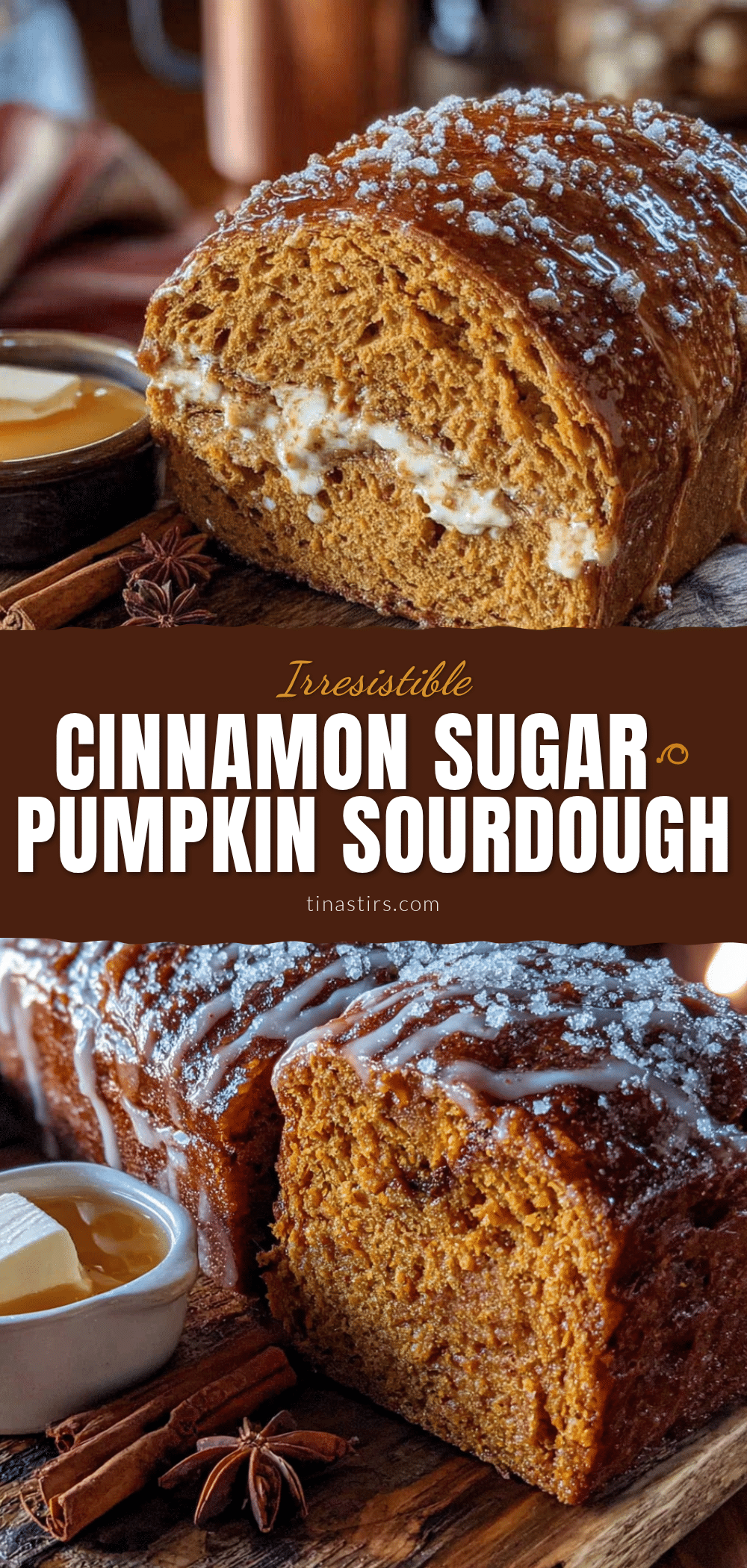
Cozy Cinnamon Sugar Pumpkin Sourdough Bread

This pumpkin sourdough bread is a cozy, forgiving loaf that fills your kitchen with the warm scents of autumn. It features a tender crumb, a subtle sourdough tang, and a crackly cinnamon sugar crust.
- Prep Time: 30 minutes
- Cook Time: 45 minutes
- Total Time: 14 hours 15 minutes (includes bulk fermentation and cold proof)
- Yield: 12 servings 1x
- Category: Bread
- Cuisine: American
Ingredients
- 1 cup (240g) pumpkin puree (not pumpkin pie filling)
- 1/2 cup (120g) active sourdough starter (fed and bubbly)
- 2 1/2 cups (315g) all-purpose flour
- 1/4 cup (60g) unsalted butter, melted
- 1/4 cup (60ml) warm water (about 90°F)
- 2 tablespoons (25g) brown sugar (light or dark)
- 1 teaspoon ground cinnamon
- 1/2 teaspoon ground nutmeg
- 1/2 teaspoon ground ginger
- 1/4 teaspoon ground cloves (optional)
- 1 teaspoon salt (fine sea salt)
- 2 tablespoons (30g) granulated sugar (for topping)
- 1 tablespoon (8g) ground cinnamon (for topping)
- 1 tablespoon (15g) unsalted butter, melted (for brushing)
Instructions
- Feed your starter 4-6 hours before mixing: ensure it is active and bubbly, doubled in size, and smells fruity and tangy.
- Mix the wet ingredients: In a large bowl, combine pumpkin puree, active starter, melted butter, and warm water. Stir until smooth.
- Add the dry ingredients: Add flour, brown sugar, cinnamon, nutmeg, ginger, cloves, and salt. Mix with a wooden spoon until a shaggy dough forms. Cover with plastic wrap and let rest for 30 minutes (autolyse).
- Stretch and fold: Perform four rounds of stretch and folds, spaced 30 minutes apart. Wet your hand, stretch one side of the dough up, and fold it over itself. Rotate the bowl and repeat on all four sides.
- Bulk fermentation: Cover the bowl and let rise at room temperature for 4-6 hours until increased by about 50% and puffy with small bubbles.
- Shape the dough: Lightly flour your work surface. Turn the dough out and gently shape it into a log. Place into a parchment-lined 9×5 inch loaf pan, seam side down.
- Cold proof: Cover the pan with plastic wrap and refrigerate for 8-12 hours (overnight).
- Preheat and prepare topping: Preheat oven to 375°F (190°C). Mix granulated sugar and cinnamon for topping in a small bowl. Remove dough from fridge and let sit at room temperature while oven heats.
- Score and top: Brush top of dough with melted butter. Score a line down the center (about 1/2 inch deep). Sprinkle cinnamon sugar mixture generously over the top.
- Bake: Place pan on middle rack. Bake for 45-50 minutes until deep golden brown and a skewer inserted into the center comes out clean. Tent with foil at 30 minutes if browning too quickly.
- Cool: Let bread cool in pan for 10 minutes, then transfer to a wire rack. Wait at least 1 hour before slicing.
Notes
If pumpkin puree is watery, blot with a paper towel before adding. For dairy-free, swap butter with coconut oil or vegan butter. Dough should be sticky but hold its shape; add extra flour if too wet. Cold proof is essential for flavor development. Score confidently about 1/2 inch deep. Check doneness at 40 minutes. Store at room temperature for up to 4 days; freeze for up to 3 months.
Nutrition
- Serving Size: 1 slice (1/12 of loa
- Calories: 185
- Sugar: 7
- Sodium: 200
- Fat: 6
- Saturated Fat: 3
- Carbohydrates: 29
- Fiber: 2
- Protein: 4
Keywords: pumpkin sourdough bread, cinnamon sugar bread, fall bread, sourdough bread, pumpkin bread, autumn baking, sourdough recipe